Oil and gas facilities rely on electrical connections to support instrumentation, control systems, monitoring equipment, and power distribution. In hazardous areas, junction boxes must do more than organize cables. They must also meet the required explosion-protection standards and withstand demanding operating conditions.
Choosing the right junction box involves evaluating the hazardous area classification, wiring configuration, environmental exposure, and installation requirements. This guide explains the key decisions engineers, contractors, and procurement teams should make when specifying junction boxes for oil and gas projects.
Identify Your Junction Box Requirements for Oil and Gas Applications
The first step is to determine what the junction box needs to accommodate. Upstream production sites, refineries, fuel terminals, and offshore platforms may have different electrical layouts and operating conditions.
For example, an instrumentation junction box may connect multiple field signals, while a power distribution application may require different conductor sizes, terminal ratings, and internal space. The enclosure should provide sufficient room for the specified terminals, wiring, and cable bending without compromising safe installation or maintenance access.
Before selecting a model, establish the following requirements:
Electrical function: Determine whether the box is intended for instrumentation, control wiring, power connections, or cable branching.
Terminal configuration: Confirm the number and type of terminals, conductor sizes, and required electrical ratings.
Installation environment: Identify whether the enclosure will be installed indoors, outdoors, in a coastal facility, or offshore.
Project specifications: Check dimensional constraints, mounting arrangements, documentation requirements, and any restrictions imposed by the project engineer.
Defining these requirements early helps prevent undersized enclosures, unnecessary customization, and costly changes during installation.
Verify Hazardous Area Classification and Certification
Oil and gas facilities may contain flammable gases or vapors, but not every area has the same level of risk. The hazardous area classification determines which equipment protection methods and certifications are acceptable.
Under the North American system, Class I locations involve flammable gases or vapors. Division 1 generally covers locations where ignitable concentrations may occur under normal operating or other specified conditions, while Division 2 addresses locations where such concentrations are generally expected under abnormal conditions.
For projects using the IEC/ATEX framework, the applicable Zone classification and equipment marking must also be verified. Division and Zone classifications should not be treated as universally interchangeable.
When reviewing a junction box specification, check:
Area classification: Confirm the required Class/Division or Zone designation.
Gas group: Ensure the equipment is suitable for the specific gases or vapors identified in the project.
Temperature rating: Verify that the equipment's maximum surface temperature is appropriate for the hazardous atmosphere.
Certification: Confirm that the exact product configuration meets the applicable code and certification requirements.
Do not rely on a general product description alone. Certification must match the intended application, including the enclosure design, installed components, and permitted cable-entry arrangements.
Choose the Right Enclosure Design and Material
The enclosure's protection concept and construction material should match both the electrical application and the site conditions.
Ex d vs. Ex e Junction Boxes
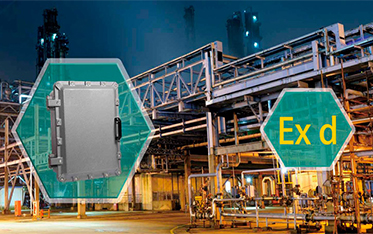
An Ex d, or flameproof, design is intended to contain an internal ignition and prevent flame propagation to the surrounding atmosphere under its specified conditions. An Ex e, or increased-safety, design focuses on preventing ignition sources and excessive temperatures through appropriate construction and component selection.
The two methods are not interchangeable. The correct choice depends on the hazardous area, internal electrical components, and applicable certification.
For projects requiring a flameproof solution, explore SUREALL's exd junction box options. The product range includes flameproof metal enclosures as well as other enclosure designs for specified hazardous-location applications. Confirm the individual model's certification and configuration before specifying it.
Select a Material for the Operating Environment
Material selection affects durability, installation, corrosion resistance, and lifecycle cost.
Aluminum: Offers a relatively lightweight metal construction and is commonly used in industrial flameproof enclosures. Suitability for coastal or offshore exposure depends on the alloy, finish, and environmental conditions.
Stainless steel: Can be appropriate for corrosive or marine environments, depending on the grade and exposure.
Glass-reinforced polyester (GRP): Provides a lightweight, corrosion-resistant option for applications where the enclosure design and certification permit its use.
There is no universally best material for every oil and gas project. Evaluate corrosion exposure, mechanical requirements, ambient temperature, maintenance needs, and the certified protection method together.
Plan Cable Entries, Terminal Capacity, and Installation
Cable routing and terminal configuration are frequent sources of installation delays. A junction box that meets the basic electrical requirements may still be unsuitable if its cable entries or internal layout do not match the project drawings.
Before finalizing the enclosure, confirm the number of incoming and outgoing cables, cable diameters, entry positions, thread types, and required cable glands. Metric and NPT entries, for example, should not be assumed interchangeable. Cable-entry devices must be compatible with the enclosure, cable type, and hazardous-location requirements.
Terminal capacity also deserves careful attention. Check the conductor sizes, electrical ratings, number of connection points, and available wiring space. Where future expansion is expected, consider whether additional terminals or cable entries can be accommodated within the approved design.
Installation planning should also address:
Mounting orientation and available working space.
Access for inspection, troubleshooting, and maintenance.
Grounding and bonding requirements.
Compatibility of seals, glands, and accessories.
Compliance with manufacturer instructions and applicable installation codes.
Any modification to an approved enclosure, including drilling additional cable entries, must follow the manufacturer's requirements and preserve the relevant certification.
Reduce Long-Term Costs Through Better Project Planning
The lowest purchase price does not necessarily result in the lowest overall project cost. Incorrect specifications can lead to installation rework, inspection failures, replacement parts, or delays while engineers resolve configuration issues.
A more effective approach is to coordinate the electrical design, procurement team, installer, and enclosure manufacturer before ordering. Providing complete drawings and specifications helps the supplier assess enclosure dimensions, terminal arrangements, cable entries, and certification requirements earlier in the process.
Environmental conditions should also be considered when evaluating lifecycle cost. A material that is suitable for a general industrial environment may not offer the same performance in a corrosive offshore location. Conversely, selecting a more expensive material without a corresponding project need may increase costs unnecessarily.
Consider the total cost of ownership, including:
Initial purchase and customization.
Installation labor and cable termination.
Inspection and maintenance accessibility.
Expected environmental exposure and replacement needs.
Required certification records and project documentation.
Early coordination can reduce avoidable changes and improve the consistency of equipment specifications across a project.
Frequently Asked Questions
What type of junction box is used in oil and gas facilities?
The appropriate type depends on the hazardous area classification, electrical function, internal components, and project specifications. Flameproof and increased-safety designs may both be used in suitable applications when their certifications and installation conditions permit.
Is stainless steel always the best choice for offshore installations?
No. Stainless steel can provide good corrosion resistance, but the appropriate grade depends on the exposure conditions. Aluminum or GRP may also be suitable for particular applications when the complete product meets the required environmental and hazardous-location specifications.
What information should I provide when requesting a quotation?
Provide the area classification, required certification, gas group, temperature rating, electrical drawings, terminal requirements, cable-entry details, enclosure material, and installation environment. These details help the manufacturer evaluate the appropriate configuration.
Find the Right Junction Box for Your Project
Selecting an explosion-protection junction box requires a coordinated assessment of electrical requirements, hazardous-area compliance, environmental conditions, and installation needs. By confirming these factors before ordering, oil and gas project teams can reduce specification errors and improve long-term equipment reliability.
Explore SUREALL's explosion-proof junction box range to review available configurations, or contact the manufacturer with your project drawings and technical requirements to discuss a suitable solution.


 English
 Español
 português
 русский
 日本語
 العربية
 français
 Deutsch
 한국어
 italiano
 Malay
 ATEX/IECEx Standard
 Each member of the SUREALL team works hard to save energy, reduce budget, maximize durability, bring success to every project for every customer. Here are just a few examples of how we've impacted the markets we're proud to serve.View More +