In industrial facilities such as steel mills, refineries, petrochemical plants, and power plants, lighting equipment may need to operate continuously in high ambient temperatures. When the surrounding temperature exceeds 50°C, conventional LED lighting can face additional thermal challenges.
For explosion proof lighting, the challenge is even greater. The luminaire must not only manage heat generated by the LED system, but also maintain the required explosion protection and temperature classification.
Understanding how high temperature affects LED components and how explosion proof luminaires are designed to manage heat is therefore important when selecting lighting for hazardous and high-temperature environments.
How High Temperature Affects LED Lighting
Temperature has a direct effect on the long-term performance of LED lighting.
LED Chip
As ambient temperature increases, it becomes more difficult for the luminaire to transfer heat from the LED junction to the surrounding environment. Excessive LED junction temperature can accelerate lumen depreciation, reduce LED lifetime, and affect long-term optical performance.
It is also important to distinguish between ambient temperature and LED junction temperature. A luminaire designed for a high ambient temperature does not mean that its internal components operate at the same temperature. Effective thermal management is required to keep the LED junction temperature within its intended operating range.
LED Driver
The driver is another critical component in high-temperature applications. Power semiconductors, control circuits, and other electronic components inside the driver are affected by operating temperature.
Continuous exposure to high temperatures can accelerate component aging and reduce the long-term reliability of the driver. Therefore, a driver should be selected according to not only the required voltage and power, but also the expected ambient and internal operating temperatures.
Capacitors
Capacitors are particularly important because their service life is strongly influenced by operating temperature. Higher temperatures can accelerate the aging of electrolytic capacitors and reduce their expected lifetime.
For this reason, high-temperature lighting applications often require components with suitable temperature ratings and a thermal design that limits unnecessary heat exposure.
Why Explosion Proof Lighting Faces Additional Thermal Challenges
Heat management is more complicated in explosion proof luminaires because explosion protection requirements can restrict conventional cooling methods.
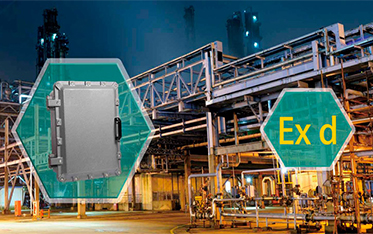
For example, flameproof Ex d equipment relies on a controlled enclosure and flameproof joints. The enclosure cannot simply use open ventilation to release heat, as this could compromise the protection concept.
Sealing requirements can also limit airflow, while the enclosed structure can cause heat generated by internal components to accumulate.
This creates a fundamental design challenge:
The luminaire must dissipate heat effectively without compromising its explosion protection.
Therefore, thermal management and explosion protection need to be considered together during the design of a high-temperature explosion proof luminaire.
Key Design Solutions for High-Temperature Explosion Proof Lighting
Separate the LED Light Source and Driver
One effective approach is to separate the LED light source from the driver compartment.
In a conventional design, the LED module and driver may be installed within the same internal space. In a separated-compartment design, the LED assembly and driver are located in different thermal environments.
This structure can reduce the amount of heat transferred from the LED assembly to the driver and help control the operating temperature of heat-sensitive electronic components.
This approach is particularly useful for explosion proof high bay lights and floodlights, where higher power levels can generate significant heat during continuous operation.
By separating the LED and driver compartments, the thermal design can be optimized for each component rather than treating the luminaire as a single thermal space.
Heat Dissipation Through the Housing
The luminaire housing plays an important role in thermal management. For explosion proof luminaires, the housing can be designed with a finned structure to increase the external surface area and improve heat dissipation to the surrounding environment.
Aluminum alloy is also commonly used for explosion proof lighting housings because it provides a good balance between mechanical strength and thermal conductivity. Compared with many other enclosure materials, aluminum alloy can effectively transfer heat from the internal LED assembly to the external surface while providing the strength required for industrial applications.
The combination of an aluminum alloy housing and a properly designed fin structure helps create a more effective thermal path and supports stable operation in high-temperature environments.
High-Temperature Rated Components
Mechanical design alone is not enough for high-temperature applications. Internal electronic components should also be selected according to the expected operating conditions.
This may include High-temperature-rated LED drivers, Temperature-rated capacitors, and Suitable insulation materials
Component selection should consider the complete thermal environment inside the luminaire rather than only the nominal ambient temperature.
Thermal Design and Explosion Protection Must Work Together
Thermal management cannot be considered separately from explosion protection.
As the internal temperature of a luminaire increases, its surface temperature may also increase. This is particularly important in hazardous areas where the maximum surface temperature must remain suitable for the surrounding gas or dust atmosphere.
Therefore, the design needs to consider several factors at the same time, including:
Ambient temperature + internal heat generation + heat dissipation + surface temperature + temperature class
A successful high-temperature explosion proof luminaire must balance these factors while maintaining its required protection concept.
Ambient Temperature vs. Temperature Class
Ambient temperature and temperature class are two different specifications and should not be confused.
Ambient temperature refers to the temperature of the surrounding environment in which the luminaire is designed to operate.
Temperature class, such as T4 or T6, refers to the maximum surface temperature of electrical equipment under specified conditions.
This distinction is especially important in high-temperature hazardous areas because a higher ambient temperature leaves less thermal margin for controlling the equipment's surface temperature.
When selecting explosion proof lighting, both the required ambient temperature rating and temperature class should therefore be checked.
Choosing Explosion Proof Lighting for High-Temperature Applications
Several factors should be considered when selecting lighting for a high-temperature hazardous area.
First, determine the actual or expected ambient temperature. Applications above 50°C may require a different luminaire configuration from standard industrial environments.
Second, identify the required temperature class and explosion protection type according to the hazardous-area classification.
Third, consider the appropriate lighting type. Explosion proof high bay lights are suitable for large industrial spaces, while explosion proof floodlights can be used for outdoor process areas, equipment areas, and other locations requiring directional illumination.
Finally, check the temperature ratings of the driver, capacitors, LED module, and other critical components. A high-temperature application should be evaluated as a complete system rather than based on the housing temperature rating alone.
Conclusion
High-temperature explosion proof lighting requires more than a temperature-resistant housing. LED chips, drivers, capacitors, thermal paths, enclosure structures, and temperature classification all need to be considered together.
For high-power explosion proof luminaires such as high bays and floodlights, separating the LED light source and driver into different compartments can be an effective thermal management approach. Combined with suitable housing design and high-temperature-rated components, this structure helps address the thermal challenges of demanding hazardous-area applications.
When selecting explosion proof lighting for environments above 50°C, users should evaluate the complete thermal design, required ambient temperature, explosion protection method, and temperature class to ensure the luminaire is suitable for its intended operating environment.


 English
 Español
 português
 русский
 日本語
 العربية
 français
 Deutsch
 한국어
 italiano
 Malay
 ATEX/IECEx Standard
 Each member of the SUREALL team works hard to save energy, reduce budget, maximize durability, bring success to every project for every customer. Here are just a few examples of how we've impacted the markets we're proud to serve.View More +