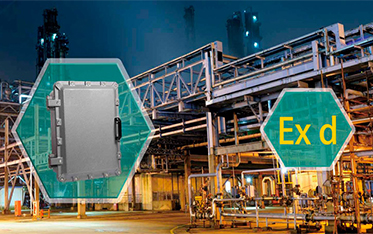
Why IP66 Does NOT Mean Explosion Proof
In industrial projects, many people assume that a high IP rating automatically means the equipment is suitable for hazardous areas. For example, some believe that IP66 means the enclosure is completely sealed, while IP67 means water cannot enter the enclosure at all. Based on this logic, they further assume that if gas cannot enter the enclosure, the equipment should also be safe for hazardous locations.
Because of these assumptions, it is very common to encounter misunderstandings such as believing that high-IP equipment is automatically explosion proof, that waterproof enclosures are suitable for hazardous areas, or that a “sealed enclosure” must be safe for Zone 1 or Zone 2 applications.
However, ingress protection and explosion protection are actually two completely different safety systems.
An IP rating is designed to evaluate how well an enclosure protects equipment from external environmental conditions such as dust, water, and solid foreign objects. Explosion protection, on the other hand, focuses on preventing the equipment from becoming an ignition source in a hazardous atmosphere. This includes preventing the ignition of flammable gas or vapor, controlling flame propagation, and limiting sparks, electrical arcs, and excessive surface temperatures.
As a result, an enclosure may perform extremely well in rain, dust, humidity, or washdown conditions, yet still be completely unsuitable for hazardous gas environments.
Understanding this distinction is critical for safe equipment selection in oil & gas facilities, chemical plants, offshore platforms, and other hazardous industrial areas.
What Is IP Protection (Ingress Protection)?
IP rating stands for “Ingress Protection” and is defined by IEC 60529. It is used to describe how effectively an enclosure prevents the entry of solid objects, dust, and water. In industrial applications, IP ratings are widely used to evaluate whether equipment can withstand environmental conditions such as outdoor exposure, washdown cleaning, humidity, dust, or temporary flooding.
The IP code typically consists of two digits. The first digit represents protection against solid objects and dust, while the second digit represents protection against liquids and water exposure.
IP Digit | Meaning | Typical Examples |
First Digit | Protection against solid objects and dust | 5 = Dust protected, 6 = Dust tight |
Second Digit | Protection against water ingress | 5 = Water jets, 6 = Powerful water jets, 7 = Temporary immersion, 8 = Continuous immersion under specified conditions |
For example, IP65 indicates that the enclosure is dust tight and protected against water jets, while IP66 provides protection against more powerful water jets. IP67 indicates protection against temporary immersion, and IP68 indicates protection against continuous immersion under specified conditions.
These ratings are extremely important in industrial and outdoor environments where equipment may be exposed to rain, dust, hose-down cleaning, high humidity, or water accumulation.
However, this is also where many misunderstandings begin.
IP testing only evaluates environmental sealing performance. It does not evaluate whether the equipment generates sparks, whether the enclosure can ignite flammable gas, whether the enclosure can withstand an internal explosion, or whether the equipment is suitable for hazardous locations.
In other words, a product can achieve a very high IP rating while still being completely unsuitable for use in hazardous gas or dust atmospheres, because IP protection and explosion protection are fundamentally different safety concepts.
What Is Explosion Protection?
In hazardous areas, the primary danger is usually not water ingress. The real risk comes from the presence of flammable gas, vapor, combustible dust, and potential ignition sources. If electrical equipment produces sparks, electrical arcs, or excessive surface temperatures, it may ignite the surrounding atmosphere and cause an explosion.
For this reason, explosion protection is specifically designed to control ignition risks in hazardous environments. The goal is not simply to prevent gas from entering the enclosure. Instead, the objective is to ensure that the equipment cannot ignite the surrounding hazardous atmosphere, even if explosive gas enters the enclosure or an internal fault occurs.
Several common explosion protection methods are widely used in industrial hazardous areas.

Unlike IP protection, explosion protection focuses on ignition control, flame containment, arc prevention, surface temperature limitation, and hazardous area suitability. As a result, explosion protection is governed by completely different standards and certification systems than ingress protection.
The following table shows the difference between common ingress protection standards and explosion protection standards used in different regions.
Environmental Protection Standards
Protection Purpose | Main Standard | Description |
IP Rating | IEC 60529 | International ingress protection standard for dust and water resistance |
NEMA / TYPE Rating | NEMA 250 | North American enclosure protection system such as TYPE 4X |
Both IP and NEMA / TYPE ratings evaluate environmental enclosure protection, including resistance to dust, water, corrosion, and outdoor conditions.
Explosion Protection Standards
Certification System | Main Standard Basis | Region / Application |
IECEx | IEC 60079 Series | International hazardous area certification system |
ATEX | EN / IEC 60079 Series | European hazardous area certification system |
NEC / UL Hazardous Locations | NEC Articles 500/505 + UL Standards | United States and Canada |
Unlike IP or NEMA ratings, these systems evaluate ignition risks, explosion containment, hazardous area suitability, and compliance for explosive atmospheres.
Why Many Explosion Proof Products Also Have IP66/IP67 Ratings
This is one of the most misunderstood topics in industrial engineering. Many explosion proof products, especially Ex d flameproof enclosures, do indeed carry high IP ratings such as IP66 or IP67. However, this does not mean that the IP rating itself is what makes the product explosion proof.
The real reason is that explosion proof construction often naturally improves environmental sealing performance. In order to achieve flameproof protection, Ex d equipment typically requires robust mechanical construction, precision-machined flamepaths, high-strength enclosure materials, and reliable sealing structures. These features are primarily designed to withstand internal explosions and prevent flame propagation, but they also improve the enclosure’s resistance to dust, water ingress, and harsh outdoor environments.
As a result, many explosion proof products naturally achieve high IP ratings as a secondary characteristic of their construction design. However, this relationship is frequently misunderstood in engineering projects.
A high IP rating is usually the result of a robust explosion proof enclosure design — not the reason the equipment is certified for hazardous areas. This distinction is extremely important because an enclosure can be IP67 without being explosion proof, while an explosion proof enclosure often ends up having strong IP performance due to its heavy-duty industrial construction.
In other words, IP protection and explosion protection may overlap in some products, but they are still fundamentally different safety concepts with different design objectives and certification requirements.
Why an IP67 Enclosure May Still Be Unsafe for Zone 1
A simple engineering comparison helps explain why a high IP rating alone does not make equipment suitable for hazardous areas.
For example, a standard industrial IP67 junction box may provide excellent waterproof performance and a fully sealed enclosure suitable for outdoor environments. It may successfully protect internal components from dust, rain, humidity, and temporary immersion. However, the internal switches, terminals, or electrical components inside the enclosure may still generate sparks, electrical arcs, or excessive heat during operation.
If the enclosure does not carry certified hazardous area approval, it has never been evaluated for explosion containment, flame propagation control, or ignition prevention. In other words, the enclosure may perform very well against water ingress while still presenting a serious ignition risk in a Zone 1 hazardous atmosphere.
This is why waterproof performance alone cannot provide hazardous area safety. An IP67 enclosure may be environmentally sealed, but without proper explosion protection design and certification, it cannot be assumed safe for explosive gas environments.
How to Properly Select Equipment for Hazardous Areas
When selecting equipment for hazardous locations, engineers should prioritize explosion protection requirements first.
Important items to verify include:
Ex marking
Zone classification
Gas group
Temperature class
IECEx or ATEX certification
Protection concept (Ex d, Ex e, Ex i, etc.)
Only after these requirements are confirmed should engineers evaluate:
This is because IP rating is an environmental protection requirement, while explosion protection is a hazardous area safety requirement.
The two are related in some cases, but they are never interchangeable.
Conclusion
IP rating protects the equipment from the environment.
Explosion protection protects the environment from the equipment.
This is the most important distinction engineers must understand.
A high IP rating does not mean a product is explosion proof.
Even a fully sealed waterproof enclosure may still create ignition risks in hazardous gas environments if it lacks proper explosion protection certification.
For hazardous area applications, safety decisions must always be based on certified explosion protection methods — not simply on sealing performance or waterproof capability.


 English
 Español
 português
 русский
 日本語
 العربية
 français
 Deutsch
 한국어
 italiano
 Malay
 ATEX/IECEx Standard
 Each member of the SUREALL team works hard to save energy, reduce budget, maximize durability, bring success to every project for every customer. Here are just a few examples of how we've impacted the markets we're proud to serve.View More +