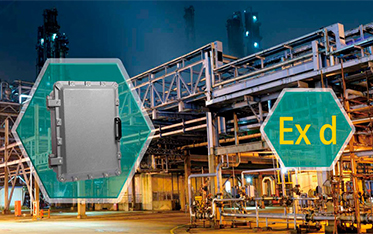
Explosion proof junction boxes are widely used in hazardous area electrical systems. Since they are responsible for cable and circuit connections, they play an important role in both electrical safety and system reliability.
Choosing the wrong junction box may lead to safety risks, compliance issues, unnecessary costs, and installation difficulties. This guide explains the key factors to consider when selecting the right explosion proof junction box for your application.
1. Why Choosing the Right Explosion Proof Junction Box Matters
An explosion proof junction box is not just a simple enclosure. It is an important part of the electrical protection system in hazardous areas.
Selecting the wrong type may create serious problems during installation and operation.
Safety Risks
· Ignition of explosive gas or dust
· Fire or explosion hazards
· Personnel injury
Compliance Risks
· Failed inspection
· Non-compliance with ATEX / IECEx / NEC requirements
Cost Risks
· Oversized enclosure increases cost
· Wrong material causes corrosion and replacement
· Wrong protection type leads to redesign
Operational Risks
· Difficult cable installation
· Lack of maintenance space
· Poor heat dissipation
Selecting the correct explosion proof junction box is not only about explosion protection, but also about long-term reliability, installation efficiency, and project compliance.
2. Identify the Hazardous Area Classification First
Before selecting any explosion proof enclosure, the hazardous area classification must be confirmed first. Different hazardous areas require different protection methods and certification levels.
The two most commonly used hazardous area classification systems are the IEC/ATEX system and the NEC system used in North America.
Although the terminology and classification methods are different, both systems follow a similar logic. They first classify the type of hazardous substance present, such as gas or combustible dust, and then determine how frequently the explosive atmosphere may be present in the hazardous area.
Based on these factors, the hazardous area is divided into different protection levels and classifications. However, the IEC/ATEX and NEC systems differ in their specific classification methods and definitions for hazardous locations.
Please refer to the table below for a comparison of the two systems.
IEC / ATEX System
Locations | Group |
EU | IEC |
Mathane under mine | Group Ⅰ | Group Ⅰ |
Hazardous Gas and Vapor | Group Ⅱ | Group Ⅱ |
Hazardous Dust | Group Ⅲ |
Hazardous Fiber |
Flammable Substances | Presence Frequency of Flammable Substances |
Present Continuously | Present Intermittently | Present Abnormally |
Gas and Vapor | Zone 0 | Zone 1 | Zone 2 |
Dust and Fiber | Zone 20 | Zone 21 | Zone 22 |
NEC / North American System
Locations | Class |
US NEC 500 |
Mathane under mine | M |
Hazardous Gas and Vapor | Class Ⅰ |
Hazardous Dust | Class Ⅱ |
Hazardous Fiber | Class Ⅲ |
Flammable Substances | Presence Frequency of Flammable Substances |
Present Continuously | Present Intermittently | Present Abnormally |
Gas and Vapor | Division 1 | Division 2 |
Dust and Fiber | Division 1 | Division 2 |
Gas Group & Temperature Class
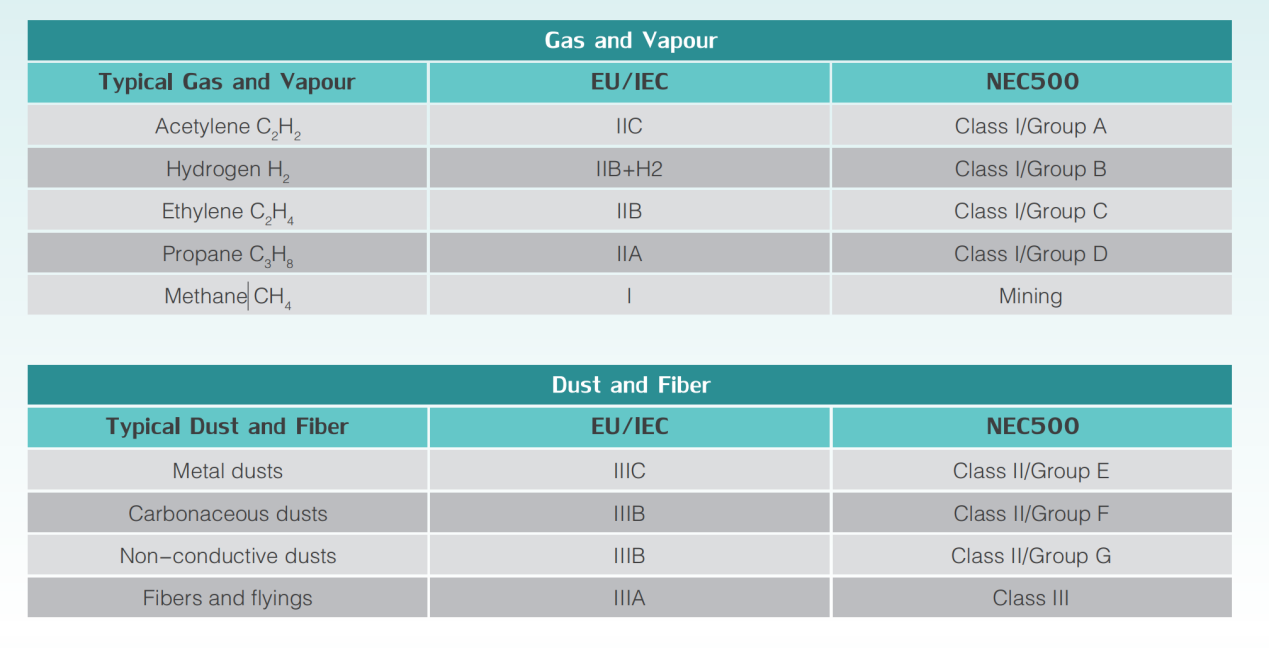
Besides the hazardous area classification, gas group and temperature class must also be considered when selecting explosion proof equipment.
Flammable substances are classified into different gas groups according to their ignition characteristics. Different gas groups represent different explosion risks, and the selected explosion proof junction box must be certified for the corresponding group.
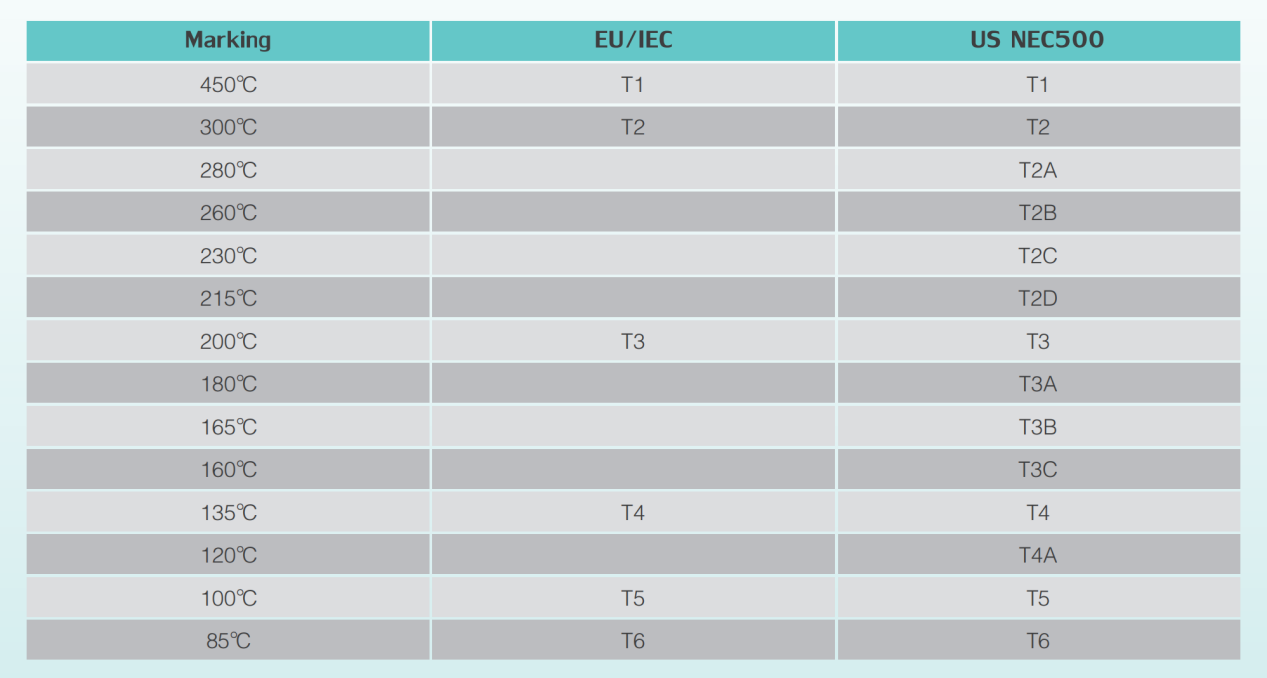
Temperature class defines the maximum surface temperature that an explosion proof product is allowed to reach during operation. This is important because an explosive atmosphere may ignite if the equipment surface temperature exceeds the ignition temperature of the surrounding gas or dust.
Explosion proof products are therefore classified into different temperature classes to ensure safe operation in hazardous areas.
Gas Groups
Temperature Classes
3. Choose the Correct Protection Type
Different explosion protection types are designed for different hazardous area applications.
The most common types used for explosion proof junction boxes are Ex d and Ex e.
Ex d (Flameproof)
Ex d enclosures are designed to withstand an internal explosion and prevent flames or hot gases from spreading to the surrounding hazardous atmosphere.
Because the enclosure must contain an internal explosion, Ex d junction boxes usually use thick and strong metal housings such as aluminum or stainless steel.
This also makes them heavier, more expensive, and more difficult to machine compared to Ex e enclosures.
Ex d junction boxes are commonly used in high-risk gas areas and applications containing breakers, relays, contactors, or other sparking components.
Ex e (Increased Safety)
Ex e protection is based on preventing arcs, sparks, and excessive temperatures during normal operation.
Since Ex e enclosures are not designed to contain an internal explosion, they can use lighter structures and are usually more economical and easier to install.
However, Ex e enclosures cannot contain components that generate sparks or arcs during normal operation.
They are widely used for terminal junction boxes, marshalling boxes, and other non-sparking applications.
Ex d vs Ex e Comparison
Item | Ex d | Ex e |
Explosion containment | Yes | No |
Allows sparking components | Yes | No |
Common hazardous area | Zone 1 / high-risk gas areas | Zone 1 / Zone 2 non-sparking applications |
Typical application | Control stations, breaker panels | Terminal & marshalling boxes |
Typical enclosure material | Aluminum / Stainless Steel | GRP / Stainless Steel |
Typical Internal Components | Breakers, relays, switches | Terminals |
Typical project priority | Maximum protection | Cost-effective wiring distribution |
If the junction box only contains terminals, Ex e is usually the preferred solution because it is lighter and more economical.
If the enclosure contains breakers, relays, or switching devices, Ex d or Ex de protection is normally required.
For Zone 1 gas areas with frequent switching operations, Ex d enclosures are commonly recommended.
4. Select the Right Enclosure Material
Environmental conditions are one of the most important factors when selecting enclosure material.
Different materials provide different levels of strength, corrosion resistance, weight, and cost.
Environmental conditions such as offshore exposure, chemical corrosion, humidity, UV exposure, and ambient temperature should always be considered during material selection.
Material | Advantages | Disadvantages | Suitable Applications |
Aluminum (AL) | Strong, good heat dissipation, common for Ex d | Corrosion in marine/coastal environments | General industrial use |
GRP (Glass Reinforced Polyester) | Lightweight, corrosion resistant, economical | Lower mechanical strength, UV aging considerations | Ex e terminal boxes, chemical plants |
Stainless Steel | Excellent corrosion resistance, hygienic, long service life | Expensive, heavy | Offshore, marine, food/pharma plants |
5. Determine Internal Components and Cable Entry Requirements
The internal configuration of the junction box directly affects enclosure size and design.
Internal Components
Typical internal components may include:
· Terminals
· Ground bars
· Relays
· Circuit breakers
· Signal isolators
More internal components usually require a larger enclosure. Heat generation and wiring space should also be considered.
Cable Entry Requirements
Cable entry requirements are often overlooked during selection.
The following items should be confirmed:
· Number of cable entries
· Cable size
· Top, bottom, or side entry
· Thread type
· Armored or non-armored cable
Space for Installation & Maintenance
Adequate internal space is important for both installation and future maintenance.
Consider:
· Bending space for cables
· Future expansion
· Easy termination
· Tool access
A junction box should not only fit the components, but also provide sufficient space for wiring and maintenance.
6. Final Checklist Before Ordering
Before placing an order, confirm the following items:
· Hazardous area classification
· Gas or dust application
· Gas group and temperature class
· Protection type (Ex d / Ex e / Ex de)
· Enclosure material
· Internal components
· Cable entry quantity and size
· IP rating
· Mounting method
· Ambient temperature
· Certification requirements (ATEX / IECEx / UL)
Choosing the right explosion proof junction box requires balancing safety, compliance, durability, and practical installation needs. By following a step-by-step selection process, users can avoid costly mistakes and ensure reliable operation in hazardous areas.


 English
  Español
  português
  русский
  日本語
日本語  العربية
  français
  Deutsch
  한국어
한국어  italiano
  Malay
Malay 
 ATEX/IECEx Standard
 Each member of the SUREALL team works hard to save energy, reduce budget, maximize durability, bring success to every project for every customer. Here are just a few examples of how we've impacted the markets we're proud to serve.View More +