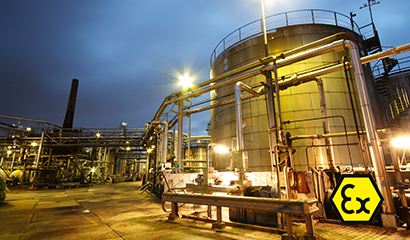
In hazardous areas, electrical equipment often needs to withstand more than one type of environmental risk. Water, dust, humidity, corrosive substances, and explosive gases or vapors can all affect equipment performance and safety.
This is why hazardous-area equipment may require two different protection mechanisms: environmental sealing and explosion protection.
Although these two concepts are sometimes confused, they serve different purposes. Environmental sealing is primarily designed to prevent external contaminants from entering an enclosure, while explosion protection is designed to control ignition hazards and prevent flames or hot gases from igniting the surrounding atmosphere.
Understanding the difference between these two protection mechanisms is important when selecting explosion-proof lighting, junction boxes, empty enclosures, and electrical panels for hazardous locations.
Why One Type of Protection Is Not Enough
An enclosure installed in a hazardous area may face two directions of risk.
From the outside, water, dust, moisture, and other contaminants can enter the enclosure and damage electrical components. This is where environmental sealing becomes important.
From the inside, an electrical fault or ignition source could ignite an explosive gas, vapor, or dust atmosphere. In this situation, the enclosure needs an appropriate explosion protection concept to prevent the ignition from becoming an external hazard.
These two requirements address different risks:
Therefore, a product can have a high IP rating without being explosion-proof, while explosion-proof equipment may also require a suitable IP rating for its installation environment.
What Is Environmental Sealing?
Environmental sealing refers to the measures used to protect an enclosure from external contaminants such as dust and water. This protection is commonly expressed through an IP (Ingress Protection) rating according to IEC 60529.
An IP rating normally consists of two digits. The first digit indicates the level of protection against the ingress of solid foreign objects, including dust, while the second digit indicates the level of protection against water.
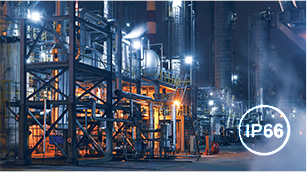
For example, IP66 means the enclosure provides a high level of protection against dust ingress and protection against powerful water jets from any direction. Higher numbers generally indicate a higher level of protection within the relevant test category, although different IP levels represent different test conditions rather than a simple "higher is always better" scale.
Environmental sealing is typically achieved through design features such as gaskets, O-rings, sealed cover joints, and properly sealed cable entries. These components help prevent water, dust, and moisture from reaching the electrical components inside the enclosure.
However, an IP rating only describes ingress protection. It does not indicate that an enclosure can withstand or contain an internal explosion.
For example, an IP66 enclosure is not automatically explosion-proof, and an explosion-proof enclosure does not automatically have a specific IP rating. The required IP rating and explosion protection concept therefore need to be evaluated separately.
What Is Explosion Protection?
Explosion protection focuses on controlling what happens when an ignition event occurs inside an enclosure, particularly how flame, hot gases, and pressure are prevented from causing a secondary hazard outside the enclosure.
This is fundamentally different from environmental sealing. IP protection is mainly concerned with preventing external water and dust from entering the enclosure, while explosion protection is concerned with controlling the effects of an internal ignition from escaping into the surrounding atmosphere.
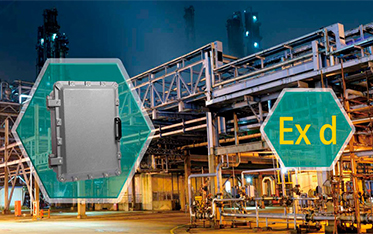
A typical example is an Ex d flameproof enclosure. Its design includes specially engineered flameproof joints, often referred to as flamepaths. These are precisely designed mating surfaces between parts such as the enclosure body and cover. The length, dimensions, and manufacturing accuracy of the flamepath are important to the overall explosion protection performance.
If an explosion occurs inside the enclosure, the flame and hot gases are forced through these carefully designed flamepaths. As they pass through the narrow and sufficiently long path, their energy is reduced and the flame is prevented from igniting the surrounding explosive atmosphere.
In simple terms, the design principle is to contain the internal explosion and control its energy before it can create a secondary hazard outside the enclosure.
Environmental Sealing vs. Explosion Sealing: Key Differences
Although both mechanisms involve the enclosure and its interfaces, their design objectives are fundamentally different.
Feature | Environmental Sealing | Explosion Protection |
Primary purpose | Prevent water, dust, and contaminants from entering | Prevent ignition from propagating to the surrounding atmosphere |
Typical standard | IEC 60529 / IP rating | IEC 60079 series and applicable certification requirements |
Main design elements | Gaskets, O-rings, seals, cable-entry sealing | Flamepaths, threaded/flanged joints, certified construction |
Main concern | Moisture, dust, corrosion, contamination | Flame propagation, hot gases, pressure and ignition |
Typical example | IP66 enclosure | Ex d flameproof enclosure |
Design philosophy | Keep external contaminants out | Control an internal ignition event |
How Environmental Sealing and Explosion Protection Work Together
Environmental sealing and explosion protection address different risks, but they often need to work together in the same hazardous-area equipment. Environmental sealing protects the enclosure and its internal components from external water, dust, and moisture, while explosion protection controls the effects of an ignition event inside the enclosure.
An explosion-proof enclosure may therefore use both mechanisms at the same time. Sealing elements such as gaskets and properly sealed cable entries help maintain the required IP protection, while the enclosure's certified explosion protection design—such as flameproof joints in an Ex d enclosure—provides protection against the propagation of an internal explosion.
An explosion-proof distribution box is a good example of how these two protection mechanisms work together. Its enclosure needs to provide suitable environmental protection for the electrical components inside, while its explosion-proof construction must also control any potential ignition event within the enclosure.
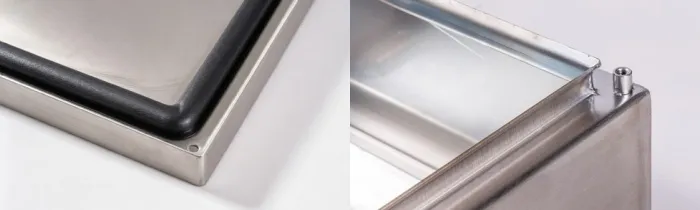
For example, the gasket and properly sealed cable entries can contribute to environmental sealing, helping prevent water and dust from entering the box. At the same time, the flameproof joint between the enclosure body and cover forms part of the explosion protection design, controlling flame and hot gases in the event of an internal explosion.
This means that environmental sealing and explosion protection should not be viewed as two competing options. They are two complementary layers of protection, with each addressing a different direction of risk.
Common Misunderstandings About IP and Explosion Protection
A common misunderstanding is that IP66 means an enclosure is explosion-proof. In fact, IP66 only defines the enclosure's protection against the ingress of dust and water. Although combustible dust can be present in some hazardous areas, explosion protection covers a much broader range of risks, including explosive gases, vapors, and dust atmospheres. Therefore, meeting IP66 alone does not make an enclosure suitable for hazardous areas.
At the same time, explosion-proof equipment will often require a suitable IP rating because environmental sealing can be an important part of maintaining the overall protection of the equipment. For example, in a dusty hazardous area, preventing combustible dust from entering the enclosure can help protect the internal components and maintain the intended protection concept. However, IP protection and explosion protection are not interchangeable. A conventional IP66 enclosure may use a gasket that is suitable for water and dust sealing, but this does not mean the same gasket can be used as the sealing element of a certified explosion-proof enclosure without considering its specific protection concept and certification requirements.
The same principle applies to cable entries. A cable entry device must not only provide the required environmental sealing against water and dust, but also meet the requirements of the applicable explosion protection concept. This is why explosion-proof equipment typically uses certified cable glands and entry devices designed for the specific type of protection and cable construction.
In short, IP protection helps keep the external environment out, while explosion protection controls the hazards that may develop inside the enclosure. They often work together, but they are not the same form of protection.
How to Choose the Right Protection for a Hazardous Area
When selecting electrical equipment for a hazardous area, both the explosion protection concept and environmental protection requirements should be considered together. Start by identifying the type of hazardous atmosphere, such as explosive gas, vapor, or combustible dust, and then determine the appropriate explosion protection type for the application. The required IP rating should also be considered based on the installation environment, especially where the equipment may be exposed to rain, dust, moisture, or water jets. Cable entries and cable glands should be compatible with both the required IP protection and the applicable explosion protection concept. Finally, factors such as enclosure material, corrosion resistance, ambient temperature, and whether the equipment is installed indoors, outdoors, offshore, or in a chemical environment should be considered to ensure reliable long-term performance.
In practice, the right solution is not simply about choosing the highest IP rating or a specific explosion-proof marking. It is about selecting an enclosure and complete configuration that provide the appropriate environmental sealing and explosion protection for the actual hazardous area and installation conditions.
Conclusion: Two Protection Mechanisms, Two Different Purposes
Environmental sealing and explosion protection are often found together in hazardous-area electrical equipment, but they solve fundamentally different problems.
Environmental sealing protects equipment from the outside environment, while explosion protection controls ignition hazards originating inside the equipment.
A gasket can help keep water and dust out. A flameproof joint can help prevent an internal explosion from igniting the surrounding atmosphere. Neither should be treated as a substitute for the other.
For explosion-proof lighting, junction boxes, empty enclosures, and electrical panels, understanding both protection mechanisms helps engineers and users select equipment that is suitable not only for the hazardous-area classification but also for the actual environmental conditions of the installation.
In hazardous areas, effective protection is rarely about choosing between environmental sealing and explosion protection. It is about understanding how the two mechanisms work together to provide reliable, application-specific protection.


 English
  Español
  português
  русский
  日本語
日本語  العربية
  français
  Deutsch
  한국어
한국어  italiano
  Malay
Malay 
 ATEX/IECEx Standard
 Each member of the SUREALL team works hard to save energy, reduce budget, maximize durability, bring success to every project for every customer. Here are just a few examples of how we've impacted the markets we're proud to serve.View More +