1. Introduction
Ex d and Ex e are two of the most common explosion protection concepts used for industrial enclosures. However, many people misunderstand the difference between them.
A common misconception is that any equipment installed in Zone 1 must use Ex d protection, or that Ex d is always safer than Ex e. In reality, both Ex d and Ex e can be used in Zone 1 hazardous areas. The correct choice mainly depends on the internal components and the actual application.
In many industrial projects, especially for control panels, the final solution is often Ex de rather than pure Ex d or pure Ex e.
This article compares Ex d, Ex e, and Ex de from several practical perspectives, including:
· Protection principle
· Enclosure structure
· Typical applications
· Maintenance requirements
· Practical selection considerations
2. What Is an Ex d Enclosure?
2.1 How Ex d Protection Works
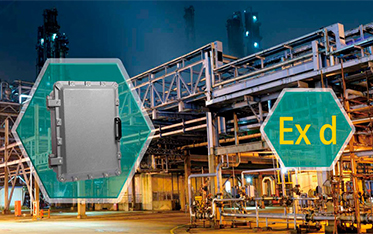
Ex d, also known as flameproof protection, is designed to contain an internal explosion and prevent it from igniting the surrounding hazardous atmosphere. Unlike other protection concepts that aim to avoid ignition, Ex d assumes that an explosion may occur inside the enclosure. The enclosure is therefore built strong enough to withstand the resulting internal pressure while preventing flames from spreading to the external hazardous area.
To achieve this, Ex d enclosures use specially designed flame paths, such as threaded joints or flanged joints, which cool the escaping hot gases before they reach the outside atmosphere. Because these flame paths must meet very strict tolerances, the enclosure requires precise machining and heavy-duty mechanical construction.
2.2 Why Ex d Enclosures Are Heavy and Expensive
Because Ex d enclosures are designed to withstand internal explosion pressure, they require thick enclosure walls, precision-machined flame paths, and strong mechanical construction. These design requirements make Ex d enclosures significantly heavier and more complex to manufacture compared to other protection types. The precise machining of flame paths also increases production cost and maintenance requirements.
In practical applications, especially for large stainless steel panels, Ex d enclosures can become extremely heavy and difficult to install, particularly in offshore platforms or space-limited areas. Maintenance is also more demanding because flame paths must remain clean, undamaged, and within the required tolerances to maintain explosion protection integrity.
2.3 Typical Applications of Ex d
Ex d is commonly used for equipment containing components that may generate arcs or sparks during normal operation.
Typical applications include:
· Contactor enclosures
· Motor starters
· Switch disconnectors
· Push button stations
· Equipment with frequent switching operations
These devices cannot normally use pure Ex e protection because they contain potential ignition sources.
In general, Ex d is better suited for equipment containing sparking or switching components.
3. What Is an Ex e Enclosure?
3.1 How Ex e Protection Works
Ex e, also known as increased safety protection, follows a completely different protection philosophy from Ex d. Instead of containing an internal explosion, Ex e protection is designed to prevent ignition from occurring in the first place. This is achieved by improving the overall safety and reliability of the equipment through enhanced insulation, secure terminal connections, larger creepage and clearance distances, and strict temperature control.
Under normal operating conditions, Ex e equipment must not generate sparks, electrical arcs, or excessive surface temperatures that could ignite the surrounding hazardous atmosphere. This requirement is both the main limitation and the main advantage of Ex e protection, as it allows for a simpler, lighter, and more economical enclosure design when no ignition source is present.
3.2 Why Ex e Enclosures Are Lighter and More Economical
Because Ex e enclosures are not designed to contain an internal explosion, they do not require thick enclosure walls, flame paths, or heavy mechanical construction. This allows the enclosure design to be simpler, lighter, and more economical compared to Ex d enclosures. Manufacturing is also generally easier because precise flame path machining is not required.
In practical applications, Ex e enclosures are often easier to install and maintain due to their lower weight and more accessible internal space. Cable termination is also typically much more convenient, especially in systems with a large number of cables and terminals.
3.3 Typical Applications of Ex e
Ex e is widely used for equipment that does not contain sparking devices.
Typical applications include:
· Terminal junction boxes
· Marshalling boxes
· Terminal enclosures
· Signal distribution boxes
These applications usually contain only terminals and wiring connections, without switching devices or ignition sources.
Ex e is especially suitable for cable-intensive applications where easy wiring and lower weight are important.
4. Where Ex de Fits In
4.1 What Is Ex de?
Ex de is a combined protection concept that uses both Ex d and Ex e within the same assembly. In a typical Ex de enclosure, the Ex d compartment is used to contain sparking components such as breakers, contactors, or switches, while the Ex e section is used for terminals, cable entries, and wiring connections.
This combination allows the enclosure to safely contain potential ignition sources inside the Ex d section while providing a more convenient and flexible area for field wiring in the Ex e section. In simple terms, Ex d handles the ignition risk, while Ex e handles the cable termination and wiring distribution.
4.2 Why Ex de Is Common in Industrial Panels
In many industrial applications, pure Ex d panels are not always practical because they can become very heavy, large in size, difficult to wire, and expensive to manufacture and install. This is especially true for complex control systems with a large number of cables and terminals. On the other hand, pure Ex e panels cannot be used for equipment containing sparking components such as breakers, contactors, or switches.
For this reason, Ex de has become a widely used solution in industrial applications. By combining Ex d and Ex e within the same assembly, Ex de provides a practical balance between safety, installation convenience, and cost. It is commonly used for control panels, local control stations, and motor control assemblies, where sparking devices need explosion protection while cable termination and field wiring still need to remain accessible and flexible.
5. Ex d vs Ex e vs Ex de — Practical Comparison
| Item | Ex d | Ex e | Ex de |
| Can contain sparking devices | Yes | No | Partially |
| Typical applications | Motor starters, disconnect switches | Terminal boxes, marshalling boxes | Control panels, mixed systems |
| Cable termination convenience | More difficult, limited space | Easy and flexible | Moderate |
| Maintenance difficulty | More complicated, flame path inspection required | Easier maintenance | Moderate |
| Suited for | Frequent switching, ignition sources inside | Simple field wiring, signal distribution | Systems containing both power and terminals |
6. How to Choose the Right Type
Step 1 — Identify the Hazardous Area
Hazardous area classification is important, but it does not automatically determine whether Ex d or Ex e should be used.
Both protection concepts may be suitable for Zone 1 applications depending on the equipment design.
Hazardous area classification alone is not enough.
Step 2 — Check Whether Sparking Components Exist
This is usually the most important step.
If the equipment contains:
· Breakers
· Contactors
· Relays
· Switches
Then Ex d or Ex de is often required.
If the enclosure contains only terminals and wiring connections, Ex e is usually sufficient. Before choosing Ex d or Ex e, confirm what the hazardous-area box will contain, because breakers and contactors create different protection requirements from terminal-only wiring.
Step 3 — Evaluate Installation and Maintenance Needs
Practical installation conditions should also be considered.
For example:
· Large cable quantities
· Limited installation space
· Offshore platforms with weight restrictions
In these situations, Ex e or Ex de may provide a more practical solution than a fully flameproof Ex d enclosure.
Step 4 — Balance Cost and Practicality
It is important to avoid unnecessary overdesign when selecting explosion protection types. In many cases, terminal junction boxes do not actually require Ex d protection because they do not contain sparking components. Using Ex d in these applications may only increase the enclosure weight, manufacturing cost, and installation difficulty without providing additional practical benefits.
In most situations, the best approach is to select the simplest protection concept that can safely meet the actual application requirements. For a side-by-side comparison of aluminum, GRP and stainless steel options, review the certified Ex d and Ex e enclosure range before confirming the final protection concept.
7. Conclusion
Ex d, Ex e, and Ex de are designed for different types of industrial applications, and none of them is universally better or more advanced than the others. The correct selection depends on several practical factors, including the internal components inside the enclosure, the presence of ignition risks, installation conditions, and maintenance requirements.
In many industrial projects, the best solution is not necessarily the strongest or most complex enclosure, but the protection concept that most effectively and practically fits the actual application.


 English
  Español
  português
  русский
  日本語
日本語  العربية
  français
  Deutsch
  한국어
한국어  italiano
  Malay
Malay 
 ATEX/IECEx Standard
 Each member of the SUREALL team works hard to save energy, reduce budget, maximize durability, bring success to every project for every customer. Here are just a few examples of how we've impacted the markets we're proud to serve.View More +