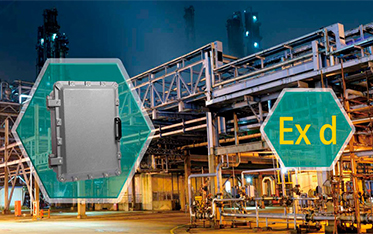
In hazardous and industrial environments, enclosure specifications often include terms such as Explosion Proof, NEMA 4X, and IP66. Because these terms may appear together on the same product, it is easy to assume that they describe the same type of protection.
They do not.
An explosion proof enclosure is designed to control ignition and explosion hazards, while a NEMA enclosure rating primarily describes protection against environmental conditions such as water, dust, and corrosion. Understanding the difference is important when selecting electrical equipment for hazardous areas.
What Is an Explosion Proof Enclosure?
An explosion proof enclosure is designed to contain an internal explosion and prevent flames or hot gases from igniting the surrounding hazardous atmosphere.
For example, Ex d (flameproof) enclosures use a specially engineered enclosure and flamepath to control an internal explosion. The design involves factors such as enclosure strength, flamepath dimensions, joints, and cable entries.
Explosion proof enclosures are commonly used in hazardous locations where flammable gases, vapors, or dust may be present, including oil and gas facilities, petrochemical plants, chemical processing areas, and mining applications.
Therefore, explosion protection is primarily concerned with ignition and explosion risks.
What Is a NEMA Enclosure?
A NEMA enclosure rating describes how well an enclosure protects its internal equipment from environmental conditions.
For example, NEMA 4 generally addresses protection against water, dust, and hose-directed water, while NEMA 4X provides similar protection with additional consideration for corrosion resistance.
NEMA ratings are commonly used for industrial control panels, junction boxes, electrical cabinets, and other equipment installed in demanding environments.
However, a NEMA rating by itself does not indicate that an enclosure is suitable for a hazardous location.
Explosion Proof vs. NEMA: What Is the Difference?
The easiest way to understand the difference is to look at what each system is designed to protect against:
Feature | Explosion Proof | NEMA Enclosure |
Main purpose | Explosion and ignition protection | Environmental protection |
Primary concern | Flammable gases, vapors, or dust | Water, dust, corrosion, etc. |
Typical requirements | Hazardous-area explosion protection standards | NEMA enclosure standards |
Suitable for hazardous areas? | When properly certified | Not necessarily |
Can replace the other? | No | No |
Is NEMA 4X Explosion Proof?
No. NEMA 4X does not mean explosion proof.
This is one of the most common misunderstandings when specifying electrical enclosures.
A NEMA 4X enclosure can provide excellent protection against water, dust, and corrosion, but this does not automatically make it suitable for installation in a hazardous area.
For hazardous-area applications, the enclosure must have the appropriate explosion protection certification and construction required for the specific application.
At the same time, an enclosure can be designed to provide both explosion protection and NEMA environmental protection. For example, an explosion proof junction box may be designed and certified for hazardous areas while also providing NEMA 4X-level environmental protection.
Explosion Proof and NEMA Can Work Together
Explosion protection and environmental protection are not competing specifications. In many industrial applications, both are required.
For example, an explosion proof junction box installed in an offshore or coastal environment may need:
Appropriate explosion protection for the hazardous area
High ingress protection against water and dust
Corrosion resistance for marine or chemical environments
Suitable cable glands and plugs to maintain the enclosure's protection
This is why products used in demanding hazardous environments may carry multiple specifications, such as Ex d, NEMA 4X, and IP66.
Each specification addresses a different aspect of the product's performance.
NEMA vs. IP Rating: Are They the Same?
NEMA ratings are also sometimes confused with IP ratings.
Both describe enclosure protection against environmental conditions, but they are based on different standards and testing methods.
An IP rating, such as IP66, indicates protection against solid particles and water ingress. NEMA classifications cover environmental protection in a broader way and may include additional considerations such as corrosion, construction, and specific types of water exposure.
Therefore, NEMA 4X and IP66 should not simply be treated as identical ratings. When a project specifies one system, the equipment should be evaluated against the applicable requirements rather than assuming direct equivalence.
Conclusion
Explosion Proof and NEMA enclosures are not the same.
An explosion proof enclosure is designed to address ignition and explosion hazards, while a NEMA rating primarily defines the enclosure's environmental protection.
In many industrial and hazardous-area applications, the best solution is not to choose between the two, but to ensure that the enclosure provides the required explosion protection together with the appropriate environmental protection.
Understanding this difference can help engineers, contractors, and equipment buyers avoid incorrect specifications and select safer, more suitable electrical enclosures for demanding applications.


 English
  Español
  português
  русский
  日本語
日本語  العربية
  français
  Deutsch
  한국어
한국어  italiano
  Malay
Malay 

 ATEX/IECEx Standard
 Each member of the SUREALL team works hard to save energy, reduce budget, maximize durability, bring success to every project for every customer. Here are just a few examples of how we've impacted the markets we're proud to serve.View More +