In hazardous areas, LED lighting must do more than provide reliable illumination. It must also withstand explosive gases, dust, moisture, vibration, and demanding temperature conditions. At the same time, the LED and electronic components inside the fixture generate heat that must be effectively managed.
This creates a particular challenge for sealed explosion-proof LED lights. Unlike conventional luminaires, Ex-proof fixtures cannot simply rely on ventilation openings to release heat. Instead, heat must be transferred through the enclosure while maintaining explosion protection and ingress protection.
Understanding the physics of thermal management helps explain how properly designed Ex-proof LED lighting can maintain stable performance and achieve a long service life.
Why Thermal Management Matters in Ex-proof LED Lighting
LEDs are highly efficient compared with traditional light sources, but not all electrical energy is converted into visible light. A significant portion eventually becomes heat.
If this heat is not properly removed, the temperature of the LED junction and other electronic components can increase. Excessive temperature may accelerate component aging, reduce light output, affect color stability, and shorten the service life of the luminaire.
For this reason, thermal management is an essential part of explosion-proof lighting design, particularly when the fixture operates continuously or in areas with high ambient temperatures. Effective thermal design must work together with other critical requirements, including explosion protection, ingress protection, electrical safety, and LED performance. By balancing these factors, an Ex-proof LED luminaire can maintain reliable operation while supporting long-term durability and service life.
The Physics Behind LED Heat Generation
The basic principle is straightforward:
Electrical Energy → Light + Heat
When electrical power is supplied to an LED, only part of the energy is converted into light. The remaining energy is released as heat.
One important parameter in LED thermal management is junction temperature (Tj), which refers to the temperature inside the LED semiconductor junction. It is different from the ambient temperature surrounding the fixture.
A simplified relationship can be expressed as:
Tj ≈ Ta + P × Rθ
Where:
Tj = LED junction temperature
Ta = ambient temperature
P = heat generated by the LED
Rθ = thermal resistance of the heat-transfer path
This illustrates why both LED efficiency and enclosure design matter. Reducing heat generation lowers the thermal load, while reducing thermal resistance allows heat to move away from the LED more effectively.
Why Sealed Ex-proof Housings Make Heat Dissipation More Difficult
A conventional lighting fixture may use ventilation openings or airflow to assist cooling. A sealed Ex-proof luminaire cannot simply adopt the same approach.
The enclosure must maintain its explosion-proof integrity and prevent hazardous gases, dust, water, or other contaminants from entering the equipment. Therefore, heat must primarily travel through the structure of the fixture rather than escaping through open ventilation.
A typical thermal path can be simplified as:
LED → PCB → Thermal Interface → Housing → External Air
This is why a key principle of Ex-proof lighting design is: Sealed does not mean thermally isolated.
A properly designed sealed enclosure can still dissipate heat effectively. The challenge is to create an efficient thermal path while maintaining the required explosion protection and IP rating.
How SureAll Controls Heat Inside a Sealed Housing
At SureAll, thermal management is considered as part of the overall luminaire design. Instead of relying on a single cooling component, the LED module, driver, enclosure material, and thermal structure are designed to work together to control heat inside a sealed Ex-proof housing.
Thermally Conductive Housing Materials
The enclosure is an important part of the heat dissipation system. Materials with good thermal conductivity, such as aluminum alloys, can efficiently transfer heat from internal components to the outer surface of the housing.
Once the heat reaches the external surface, it can be released into the surrounding environment through natural convection and thermal radiation. This makes enclosure material selection an important factor in the thermal performance of a sealed Ex-proof luminaire.
LED Module and Driver
Both the LED module and driver generate heat during operation and therefore affect the thermal performance of the luminaire. Using efficient LED components and reliable drivers can reduce heat generation, while appropriate component selection, layout, and thermal connection help transfer heat away from these sources. Together, these measures support stable light output, controlled operating temperatures, and long-term reliability.
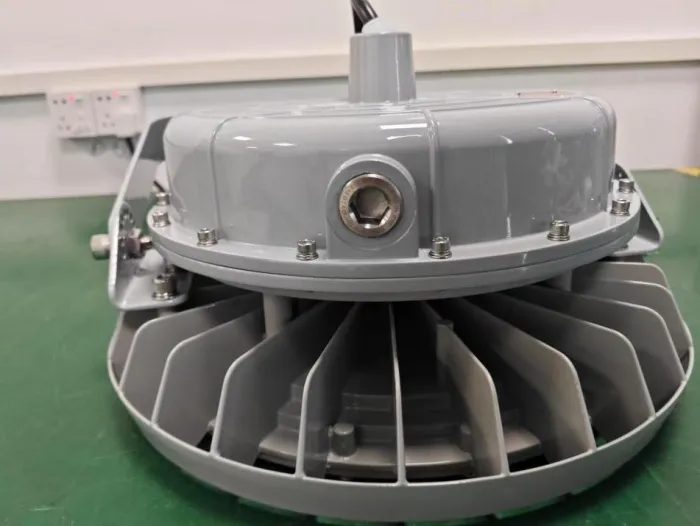
Optimized Thermal Path and Fin Structure
Effective thermal management is not simply about using a larger heat sink. What matters is how efficiently heat moves from the heat source to the external surface.
A well-designed thermal path minimizes thermal resistance between the LED module, PCB, thermal interface, and housing. At the same time, an external fin structure can increase the effective surface area of the housing, allowing more heat to be transferred to the surrounding air through natural convection.
By combining an efficient internal thermal path with an optimized external fin structure, the housing can function as an integrated heat-dissipation system while maintaining the sealed structure required for Ex-proof protection.
Heat Dissipation Mechanisms: Conduction, Convection and Radiation
Heat moves through three fundamental mechanisms: conduction, convection, and radiation.
Conduction
Conduction is particularly important inside a sealed Ex-proof luminaire.
Heat can move from the LED through the PCB and thermal interface into the metal housing. The housing then distributes the heat over a larger surface area.
Convection
Once heat reaches the external surface, the surrounding air absorbs heat from the housing. This process is known as convection.
Natural convection can occur without fans or moving parts, which is particularly useful for sealed industrial lighting equipment.
Radiation
The external surface of the fixture also releases thermal energy through infrared radiation.
In a sealed Ex-proof luminaire, effective thermal management therefore depends heavily on conduction through the housing, followed by heat transfer from the external surface through convection and radiation.
Temperature Management and LED Lifetime
Thermal management has a direct relationship with LED longevity.
When an LED operates at an excessively high junction temperature for extended periods, several effects may occur:
Faster LED degradation
Reduced lumen output over time
Potential color shift
Accelerated aging of electronic components
Reduced driver reliability
This is why the distinction between ambient temperature and junction temperature is important.
For example, a luminaire specified for an ambient operating temperature of +60°C does not mean that the LED junction itself remains at 60°C. The junction temperature depends on the LED power, thermal resistance, enclosure design, and surrounding conditions.
A reliable Ex-proof luminaire must therefore be designed to keep internal component temperatures within appropriate operating limits under the specified ambient conditions.
Thermal Management Under Real Hazardous-Area Conditions
The actual installation environment also affects the thermal performance of an Ex-proof LED luminaire. High ambient temperatures, direct sunlight, continuous operation, limited airflow, and other industrial conditions can increase the thermal load on the fixture. Therefore, thermal management should be evaluated not only by the luminaire's internal design, but also by the environmental conditions in which it will operate.
For hazardous-area applications such as oil and gas, petrochemical, offshore, and mining facilities, considering the actual ambient conditions is essential for maintaining stable LED performance and long-term reliability.
Thermal Management Is Part of Explosion-proof Lighting Design
Explosion protection is not only about containing an internal ignition or preventing an external hazardous atmosphere from entering the equipment. A reliable Ex-proof luminaire must also manage the heat generated during normal operation.
Effective thermal design brings together:
Explosion protection + IP protection + thermal management + electrical performance + material selection
For sealed Ex-proof LED lighting, these factors cannot be treated independently. The enclosure must provide the required protection while also functioning as part of the thermal pathway.
By considering the LED module, driver, thermal interfaces, enclosure material, heat-transfer path, and operating environment as one system, SureAll designs Ex-proof LED lighting to maintain stable operation and support long-term LED performance in demanding hazardous environments.
Ultimately, good thermal management is not simply about making an LED fixture cooler. It is about controlling heat throughout the entire system so that the luminaire can deliver reliable illumination, safety, and durability over its service life.
Conclusion
For Ex-proof LED lighting, thermal management is a fundamental part of reliable product design. The challenge is to remove heat effectively without compromising the sealed structure required for hazardous-area protection.
Through efficient LED components, optimized thermal paths, suitable enclosure materials, thermal interfaces, and driver management, SureAll integrates heat control into the overall design of its sealed Ex-proof lighting solutions.
The result is not simply a cooler luminaire, but a more stable and durable lighting system designed for the demanding conditions of hazardous industrial environments.


 English
  Español
  português
  русский
  日本語
日本語  العربية
  français
  Deutsch
  한국어
한국어  italiano
  Malay
Malay 
 ATEX/IECEx Standard
 Each member of the SUREALL team works hard to save energy, reduce budget, maximize durability, bring success to every project for every customer. Here are just a few examples of how we've impacted the markets we're proud to serve.View More +